
Isaque Dutra
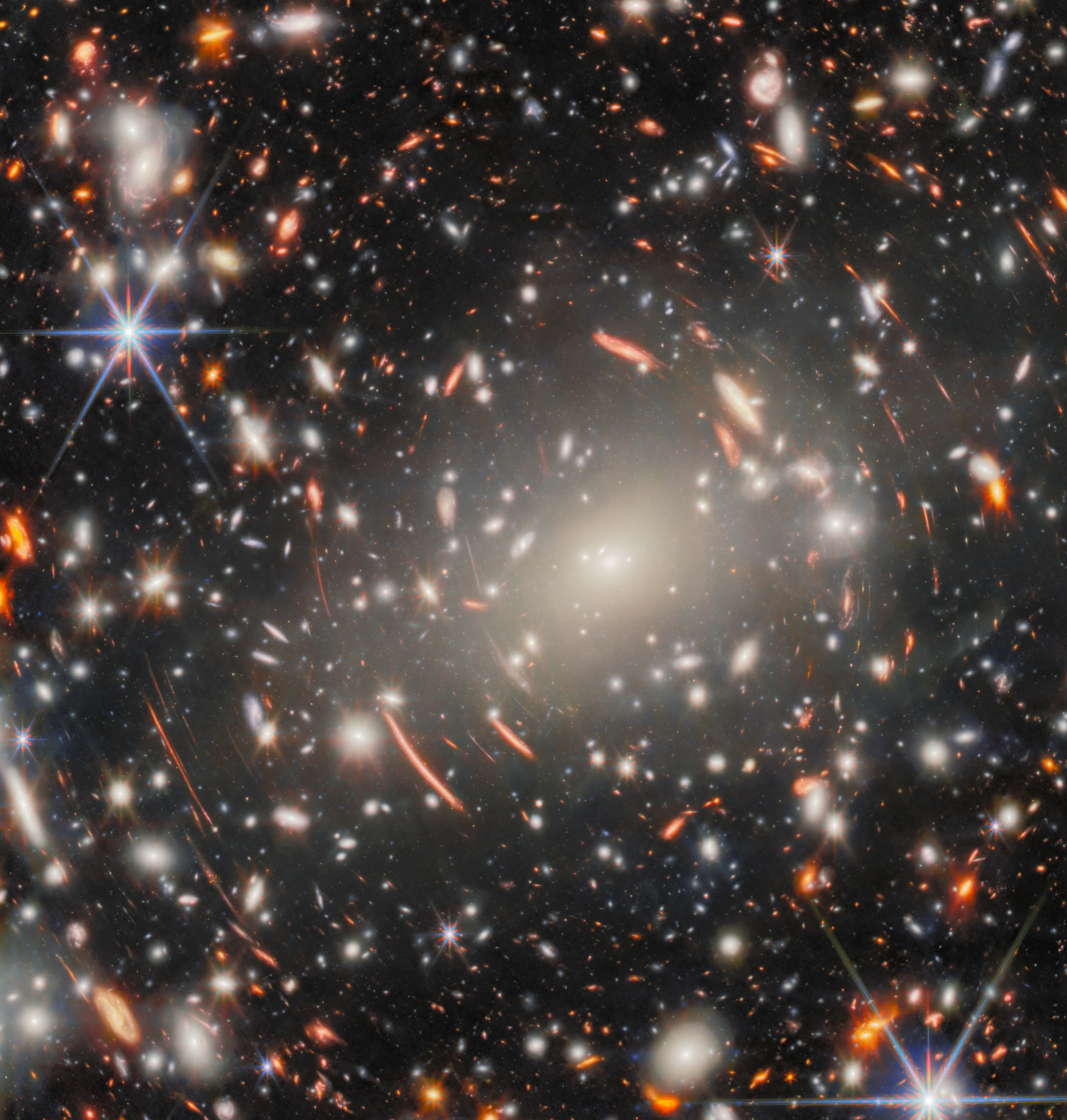
The galaxy cluster Abell S1063 observed with the James Webb Space Telescope: a bright central galaxy surrounded by cluster members and thin red arcs of lensed background galaxies.

Astrophysics & Cosmology

Isaque Dutra

PhD student · Department of Physics · Yale University

I study dark matter and the expansion of the Universe through gravitational lensing and AGN variability.

ResearchPublications

About

Galaxy clusters as laboratories for dark matter

I use galaxy clusters, the most massive gravitationally bound structures in the universe, as laboratories for studying dark matter. By comparing the dark matter distributions inferred from gravitational lensing with cosmological simulations, I investigate whether discrepancies between observations and predictions reflect limitations in our models or point toward alternate dark matter physics.

With collaborators, I have also used the variability of active galactic nuclei (AGN) as a cosmological distance probe to investigate the cosmic expansion and the possible evolution of dark energy.

Isaque Dutra
New Haven, October 2026

Research

Three questions

  1. Dark matter

    Why do cluster galaxies lens more strongly than cold dark matter predicts?

    Observed galaxy clusters produce nearly ten times more galaxy–galaxy strong lensing than ΛCDM simulations predict, and I use this discrepancy to probe the nature of dark matter. By measuring how strongly each member galaxy lenses, both on its own and embedded in the cluster, we have shown that the gap has two sources: simulated galaxies are not centrally concentrated enough, and too few of them sit where the cluster’s lensing field is strongest. We investigated whether self-interacting dark matter (SIDM), whose subhalos can undergo gravothermal core collapse and grow steep, dense centres, could supply the missing concentration. A contraction that mimics this core collapse recovers the first effect but not the second, pointing to differences in both the inner structure and the locations of cluster galaxies.

  2. Distance probes

    Can AGN variability measure cosmic distances?

    AGN variability may offer a way to measure distances across cosmic history. With collaborators, I investigate how the relationship between variability and intrinsic luminosity can be used for cosmology. The goal is to develop a reliable distance probe that reaches high redshift and to understand the assumptions and uncertainties that shape its conclusions.

  3. Dark energy

    Does dark energy evolve over time?

    I use the distance ratios encoded in gravitational lensing and the distances inferred from AGN variability to investigate how the Universe has expanded over time. These approaches provide complementary ways to test whether the expansion history is consistent with a cosmological constant or suggests that dark energy has evolved since the Big Bang.

Publications

Papers and preprints

3 first-author · 6 coauthored

First-author

2026

Where Cluster Galaxies Reside and How Strongly They Lens

Isaque Dutra, Priyamvada Natarajan, Cian Roche

Preprint · Submitted to ApJarXiv:2610.14167

Abstract

We separate the effects of galaxy structure and cluster environment on galaxy–galaxy strong lensing, finding that the discrepancy between observations and simulations reflects both insufficient central concentration in simulated members and differences in their locations within the cluster lensing field. A mass-conserving contraction that mimics core-collapsed self-interacting dark matter largely recovers the conditional lensing fractions, but does not resolve the difference in the fraction of members occupying cluster-critical regions.

2025

Evidence for evolving Dark Energy from a new cosmic probe

Isaque Dutra, Colin J. Burke, Priyamvada Natarajan, Weixiang Yu

Preprint · Revised manuscript submitted to NaturearXiv:2512.07931

Abstract

We establish a relation between AGN variability and intrinsic luminosity, introducing a new cosmological distance probe that extends to high redshift. Combining the resulting Hubble diagram with supernova observations yields evidence for evolving dark energy within the models tested.

2025

Self-interacting Dark Matter, Core Collapse, and the Galaxy–Galaxy Strong-lensing Discrepancy

Isaque Dutra, Priyamvada Natarajan, Daniel Gilman

The Astrophysical Journal, 978(1), 38arXiv:2406.17024DOI

Abstract

Observed galaxy clusters produce substantially more galaxy–galaxy strong lensing than standard cold dark matter simulations predict. We show that steepening subhalo density profiles can alleviate this discrepancy, identifying core collapse in self-interacting dark matter as a promising mechanism for further investigation.

Coauthored

2026

SLICE: Unveiling the Multi-Component Merging Core of SPT-CLJ1150-2805 Through Strong-Lensing Mass Modelling

James R. Betts, Benjamin Beauchesne, Mathilde Jauzac, David Lagattuta, Guillaume Mahler, Jean-Paul Kneib, Gavin Leroy, Marceau Limousin, Priyamvada Natarajan, Sameeksha Saini, Keren Sharon, Stephane V. Werner, Catherine Cerny, Isaque Dutra, Dominique Eckert, Alaina Einsig, Michael D. Gladders, Gourav Khullarm, Manon Regamey

Preprint · Submitted to MNRASarXiv:2609.31944

Abstract

We combine strong-lensing, X-ray, and spectroscopic observations to map the merging cluster SPT-CLJ1150-2805, resolving five cluster-scale dark matter halos and a bimodal core. The mass reconstruction remains stable when additional photometric multiple images are included, supporting the use of this exceptionally powerful gravitational lens to study distant galaxies.

2026

Host Dependence and Line-of-Sight Effects on Galaxy-Galaxy Strong Lensing in Clusters

Cian Roche, Michael McDonald, Priyamvada Natarajan, Keren Sharon, Isaque Dutra, Massimo Meneghetti, Mark Vogelsberger

PreprintarXiv:2608.30079

Abstract

We quantify how cluster properties, baryonic physics, and line-of-sight structure affect galaxy–galaxy strong lensing. Matching observed and simulated clusters in mass and Einstein radius reduces the apparent discrepancy, but its remaining significance depends strongly on the measurement boundary.

2026

A Consistent Implementation of Cluster Strong Lensing in Cosmological Simulation Light Cones

Cian Roche, Mark Vogelsberger, Michael McDonald, Isaque Dutra, Priyamvada Natarajan, Xuejian Shen, Soumya Shreeram, R. Benton Metcalf, Keren Sharon, Simon Birrer, Wonki Lee, Massimo Meneghetti

PreprintarXiv:2605.30433

Abstract

We develop a framework that generates strong-lensing images with lenses, sources, and intervening matter drawn consistently from cosmological simulations. The resulting light cones reveal how line-of-sight structure shifts image positions and changes critical curves, improving the basis for comparisons with observed clusters.

2026

New Cold Dark Matter Crisis Revealed by Multiscale Cluster Lensing

Priyamvada Natarajan, Barry T. Chiang, Isaque Dutra

The Astrophysical Journal Letters, 1001(1), L12arXiv:2601.07909DOI

Abstract

We combine lensing constraints across multiple scales to test whether cold dark matter can explain the structure of cluster subhalos. Their mass functions and tidal extents agree with predictions, while their inner density profiles and radial distributions reveal significant discrepancies that challenge a unified description.

2026

Constraining the Nature of Dark Matter from Tidal Radii of Cluster Galaxy Subhalos

Barry T. Chiang, Isaque Dutra, Priyamvada Natarajan

The Astrophysical Journal, 997(1), 106arXiv:2511.14726DOI

Abstract

We use subhalo tidal radii in eight galaxy clusters to test the nature of dark matter beyond subhalo cores. Their observed extents are consistent with cold dark matter predictions and challenge the strongly collisional self-interacting regime studied, providing an independent complement to constraints from central density profiles.

2024

The Galaxy–Galaxy Strong Lensing Cross Section and the Internal Distribution of Matter in ΛCDM Substructure

Yarone M. Tokayer, Isaque Dutra, Priyamvada Natarajan, Guillaume Mahler, Mathilde Jauzac, Massimo Meneghetti

The Astrophysical Journal, 970(2), 143arXiv:2404.16951DOI

Abstract

We investigate whether changes to the internal distribution of matter in cluster subhalos can explain the observed excess of galaxy–galaxy strong lensing. Standard cold dark matter profiles, even with baryonic contraction, do not resolve the discrepancy, strengthening the motivation to investigate alternative explanations.

Contact

Get in touch

Department of Physics, Yale University